
Industrial Propane Cylinder Parts - Forklifts and Buffers
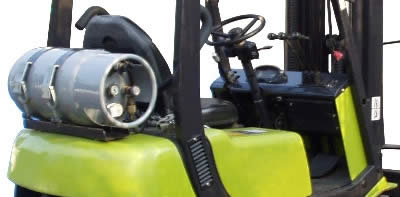
Propane is widely used by many companies and industries across the United States. Propane cylinder service is offered by most propane companies and is growing due to the portability of propane as an energy source and alternative fuel. Primarily used in liquid service, these cylinders can be spotted on the back of forklifts all over the nation. Additionally, propane powered forklifts and similar equipment can be operated indoors due to the clean burning characteristics of propane. Outlined here is an overview of the parts and fittings commonly found on industrial propane cylinders.
Industrial Propane Cylinders
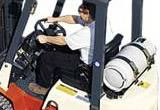
Propane cylinders used on forklifts or other similar equipment utilizing liquid propane as a fuel source are quite common among many different industries and are used indoors and outdoors. Industrial propane bottles are commonly made of steel or aluminum and found in three sizes: 20# cylinders, 33# cylinders and 40# cylinders. Forklifts are usually powered by the 33# propane bottles with larger lifts sometimes using the 40# cylinders. The 20# propane bottles are usually used on propane floor buffers seen in grocery stores.
Industrial/Forklift Cylinder Fittings
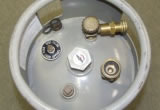
Similar to an ASME propane tank, a cylinder designed for industrial service such as on a forklift, has fittings and connections installed independently on the propane cylinder. Although the fittings function the same, they are specialized for use with an industrial propane cylinder used primarily in liquid service. These fittings include: relief valves, bleeder valves, forklift service valves, float gauges, and filler valves. Service valves on a forklift bottle communicate with the liquid space of the cylinder but can often be converted to be used in vapor service for applications requiring LP Gas vapor.
Propane Forklift Cylinder Gauge
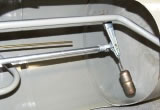
The gauge on a propane forklift cylinder can sometimes be misleading and confusing for forklift operators. It is important to know that the gauge will only indicate a correct reading when the cylinder is installed horizontally and properly mounted on the lift truck. The gauge is not designed to accurately depict the propane level when the tank is positioned vertically. Although many forklift bottle gauges are labeled for both horizontal and vertical readings, the vertical reading will generally depict if there is any propane in the bottle. The gauge won't show the level of propane in the bottle. In other words, propane forklift cylinder gauges only indicate the presence of liquid propane, not how much gas remains.